
An essential oil is a concentrated fragrant extract from a plant, obtained mainly by steam from leaves, flowers or fruit, and in citrus fruits by cold pressing the peel. Essential oils are not fats like jojoba or almond oil, so they do not soak into the skin like a cream but evaporate. If you are curious how scent gets into cosmetics, take a look at the oil perfume Voňafka Lipa or the whole oil perfumes category.
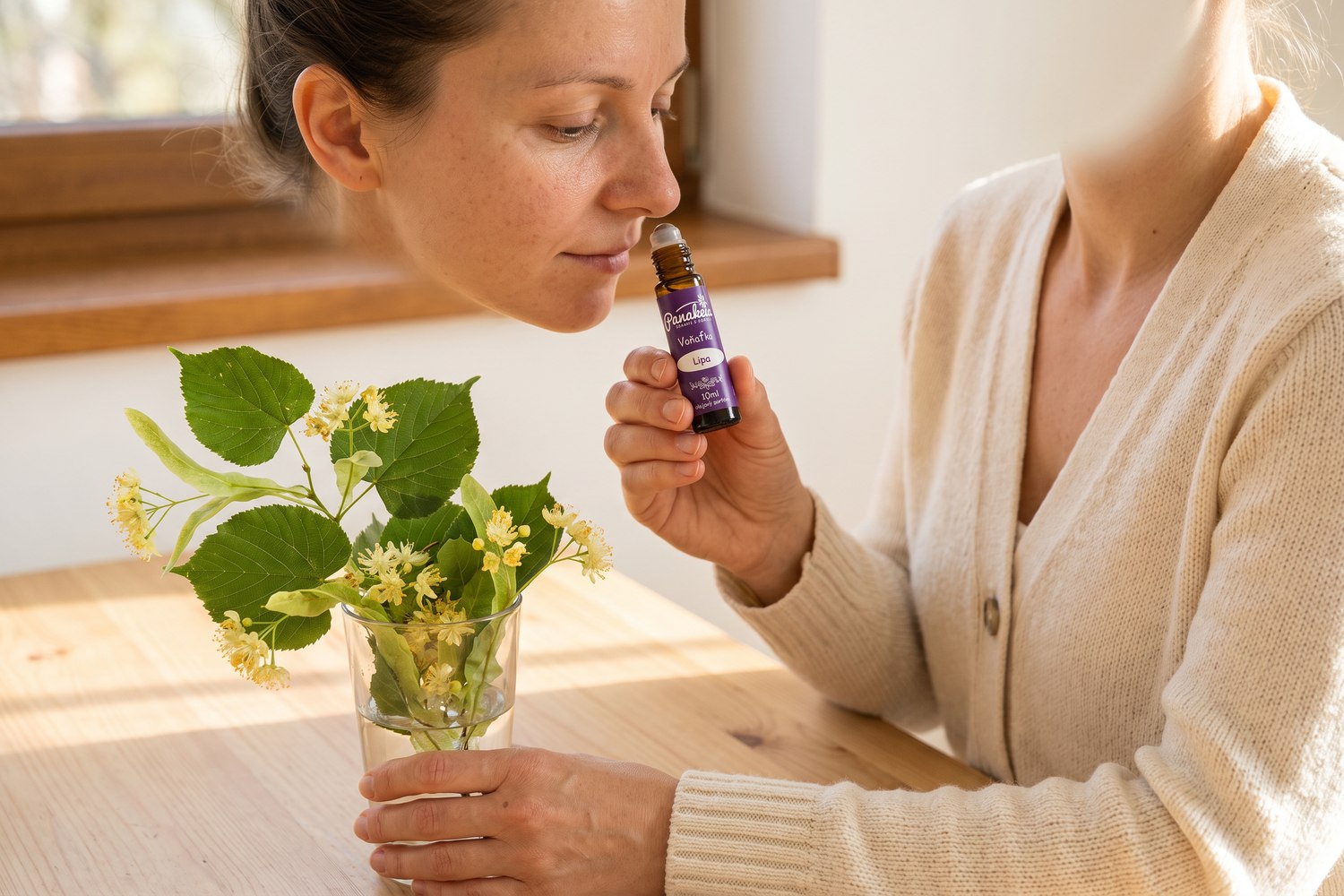
Why are they called oils when they are not fats?
The name comes from the look: a liquid drop spreads on paper like oil, but after a while it evaporates and leaves no greasy stain. That is the main difference from plant oils, which are made of fatty acids, do not evaporate and serve as a carrier. The names ethereal oil or volatile oil are also used; it is the same type of substance. A small bottle needs a large amount of plant material, so essential oils cost more than ordinary plant oils, and small amounts are used in practice. An interesting case is jojoba oil, which chemically is a liquid wax and is used as a carrier oil, for example in the oil perfume Voňafka Lipa.
Essential oil, carrier oil and fragrance: what is what on the label
When reading a composition, four terms are most often confused. An essential oil has a botanical name and the word Oil, a carrier oil is a fatty plant oil or liquid wax, and Parfum is the collective name for a fragrance composition, which may contain natural as well as synthetic substances. An overview on real products will help.
| Term | What it is | How you find it in the composition | Example |
|---|---|---|---|
| Essential oil | a volatile plant extract | botanical name and Oil | Citrus Limon Peel Oil in the hand cream |
| Carrier oil | a fatty plant oil or liquid wax | for example Simmondsia Chinensis Seed Oil | jojoba oil in Voňafka Lipa |
| Parfum | the collective name for a fragrance composition | the word Parfum | Voňafka Magdaléna |
| Fragrance allergens | components of the scent listed separately | Limonene, Linalool, Citral, Geraniol | the end of the ingredient list |
Fragrance allergens are natural components of many essential oils and fragrance compositions. Under the cosmetics regulation the manufacturer lists them separately if their amount in the product exceeds the limit set by law, so you find them on the label even when the scent comes from plants. It is not a mistake or a sign of a cheap fragrance; it is useful information for women who react more sensitively to scents, and for anyone who wants to choose consciously. If you are one of them, look at the end of the ingredient list before you buy and choose a product where the scent can be read in full, not one that says nothing about it, and if in doubt ask us or the manufacturer.
Five essential oils you will meet most often
The same word on a bottle can hide different species, so when buying look at the botanical name. True lavender and lavandin, for example, are two different plants; lavandin is a hybrid with a sharper, more herbal scent. The table shows which part of the plant and by what method the individual oils are most often obtained. Citrus oils from pressed peel are more sensitive to light and air than oils from leaves, so they belong in dark glass and, once opened, are best used within a reasonable time. In finished products the scent is usually made up of several oils and bound into the base of a cream or oil, so it does not reach your hands in pure concentrated form.
| Essential oil | Botanical name | Part used | Method of obtaining | Character of scent |
|---|---|---|---|---|
| Lavender | Lavandula angustifolia | flowering tops | steam distillation | floral, lightly herbal |
| Lemon | Citrus limon | fruit peel | cold pressing | fresh citrus |
| Peppermint | Mentha x piperita | leaves | steam distillation | cooling minty |
| Tea tree | Melaleuca alternifolia | leaves | steam distillation | sharp herbal |
| Litsea cubeba | Litsea cubeba | fruits | steam distillation | citrusy, grassy |

How are essential oils used in cosmetics and at home?
In cosmetics they give a product its scent, always in a small amount dispersed in a base, which is a cream, an oil or a perfumed oil. At home the scent is dispersed through a diffuser, an aroma lamp or scented wax, where heat or a current of air releases it into the room. In each of these ways it is about a sensory experience, a moment of slowing down and a pleasant scent, not about treatment. An essential oil does not belong on the skin undiluted; it reaches the body dissolved in a carrier oil or in a finished product. You will always find the exact proportions and instructions on the label of the particular product; follow the manufacturer there, not general tables from the internet. If you have sensitive skin, first do a test on a small area, for example on the forearm, and wait to see whether redness or itching appears.
Principles of safer handling
- Do not apply undiluted essential oil directly to the skin.
- Avoid the eyes, mucous membranes and damaged skin.
- Do not drink them or add them to food; they are cosmetic and fragrance substances.
- Keep them out of the reach of children and pets.
- With a diffuser or aroma lamp, ventilate the room and do not leave them switched on unattended.
What to look at when buying an essential oil
You recognise the quality of essential oils not by the price or a pretty package but by the information the manufacturer provides. A good bottle has on the label a botanical name, not just the word lavender, the part of the plant, the volume, the batch and a contact for the responsible person in the European Union. Notice also whether it is a pure oil or a blend in a carrier oil, because the way you use it changes accordingly, and look at the list of fragrance allergens too, which says more about the composition than a slogan. Price and a beautiful package guarantee nothing in themselves, so it is worth pausing over the label and reading it slowly, the way you read the composition of a cream. If you want to go deeper, read studies on fragrance allergy. The rules for cosmetics in the European Union are set by Regulation (EC) No 1223/2009 on cosmetic products.
Did you know…
Did you know that on a cosmetics label an essential oil is usually written with its botanical name and the word Oil, for example Citrus Limon Peel Oil?